Nvidia vs AMD: 10-Year Scorecard
2016 - 2025


The Verdict
Year-by-Year Performance
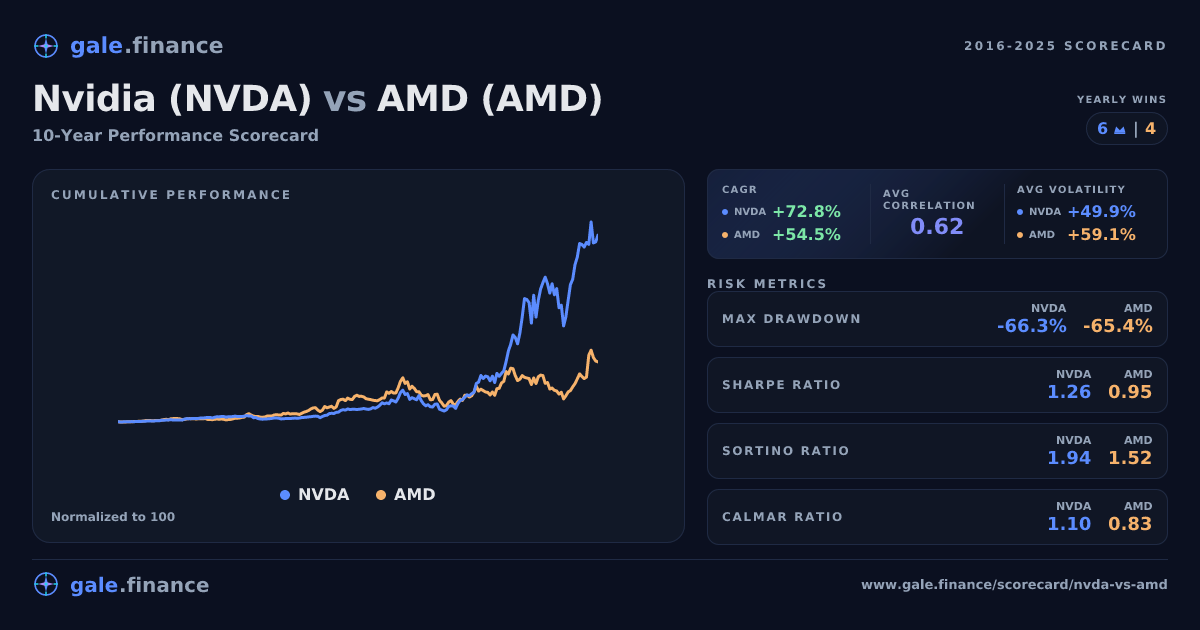
Over 10 years, NVDA won 6 individual years while AMD won 4.
| Year | Nvidia | AMD | Winner |
|---|---|---|---|
| 2016 | +232.9% | +309.4% | AMD |
| 2017 | +90.4% | -10.1% | NVDA |
| 2018 | -32.8% | +68.1% | AMD |
| 2019 | +73.4% | +143.5% | AMD |
| 2020 | +118.0% | +86.8% | NVDA |
| 2021 | +124.5% | +55.9% | NVDA |
| 2022 | -51.4% | -56.9% | NVDA |
| 2023 | +246.1% | +130.3% | NVDA |
| 2024 | +178.9% | -12.8% | NVDA |
| 2025 | +34.9% | +77.5% | AMD |
| Total Wins | 6 wins | 4 wins | NVDA |
Cumulative Performance
This chart shows how $100 invested at the start of 2016 would have grown over time.
Price Comparison
Normalized to 100 at start date for comparison
Risk-Adjusted Metrics
How did each asset perform relative to the risk taken? Higher Sharpe, Sortino, and Calmar ratios indicate better risk-adjusted returns.
Tail-risk definitions: Value at Risk (VaR), Expected Shortfall, skew, kurtosis, and fat tails.
| Metric | NVDA | AMD |
|---|---|---|
| Total Return | +23517.4% | +7631.4% |
| CAGR | +72.8% | +54.5% |
| Volatility (Ann.) | +49.9% | +59.1% |
| Sharpe Ratio | 1.26 | 0.95 |
| Sortino Ratio | 1.94 | 1.52 |
| Calmar Ratio | 1.10 | 0.83 |
| Max Drawdown | -66.3% | -65.4% |
Sharpe and Sortino ratios use the period-average risk-free rate based on the 3-month U.S. Treasury yield (FRED: DGS3MO). To reproduce: take the simple average of daily DGS3MO values from 2016-01-01 to 2025-12-31; in this window the average is 4.23%.
Tail Risk & Distribution Shape
Tail-risk metrics summarize how each asset behaved on extreme days from 2016 to 2025. We compute them from daily log returns ( ).
VaR and Expected Shortfall (ES/CVaR) are historical (non-parametric) 1-day metrics and are not annualized.
| Metric | NVDA | AMD |
|---|---|---|
| Return observations (n) | 2513 | 2513 |
| 5% VaR (daily) | -4.67% | -5.47% |
| 5% Expected Shortfall (daily) | -7.02% (avg of worst 126 days) | -7.99% (avg of worst 126 days) |
| 1% VaR (daily) | -7.98% | -9.33% |
| 1% Expected Shortfall (daily) | -10.79% (avg of worst 26 days) | -12.08% (avg of worst 26 days) |
| Skew | 0.09 | 0.62 |
| Excess kurtosis | 6.63 | 10.52 |
| 2σ tail days (down/up) | 74 / 55 | 65 / 65 |
| |z| > 3σ days (observed vs expected) | 27 (6.78) | 29 (6.78) |
| Worst day (simple return) | -18.76% (2018-11-16) | -24.23% (2017-05-02) |
| Best day (simple return) | +29.81% (2016-11-11) | +52.29% (2016-04-22) |
Downside Co-moves (Tail Dependence)
Using shared closes, a “tail day” is when each asset is in its own worst 5% (or 1%) of days in 2016–2025.
Show co-crash dates
These are shared-date intervals when both assets were in their own worst-tail days (shown as simple returns). Most recent 30 dates are shown.
Both in worst 5% days
| Date | NVDA | AMD |
|---|---|---|
| 2021-03-18 | -4.64% | -5.46% |
| 2021-12-16 | -6.80% | -5.37% |
| 2022-01-05 | -5.76% | -5.73% |
| 2022-02-11 | -7.26% | -10.01% |
| 2022-04-26 | -5.60% | -6.10% |
| 2022-05-05 | -7.33% | -5.58% |
| 2022-05-06 → 2022-05-09 | -9.24% | -9.42% |
| 2022-05-18 | -6.82% | -6.04% |
| 2022-06-10 → 2022-06-13 | -7.82% | -8.26% |
| 2022-06-16 | -5.60% | -8.12% |
| 2022-06-28 | -5.26% | -6.24% |
| 2022-08-26 | -9.23% | -6.17% |
| 2022-09-13 | -9.47% | -8.99% |
| 2022-09-22 | -5.28% | -6.69% |
| 2022-10-07 | -8.03% | -13.87% |
| 2022-11-09 | -5.66% | -6.16% |
| 2022-12-22 | -7.04% | -5.64% |
| 2023-05-31 | -5.68% | -5.64% |
| 2023-08-02 | -4.81% | -7.02% |
| 2024-04-19 | -10.00% | -5.44% |
| 2024-07-17 | -6.62% | -10.21% |
| 2024-07-24 | -6.80% | -6.08% |
| 2024-08-01 | -6.67% | -8.26% |
| 2024-08-30 → 2024-09-03 | -9.53% | -7.82% |
| 2025-01-24 → 2025-01-27 | -16.97% | -6.37% |
| 2025-04-03 | -7.81% | -8.90% |
| 2025-04-04 | -7.36% | -8.57% |
| 2025-04-10 | -5.91% | -8.41% |
| 2025-04-16 | -6.87% | -7.35% |
| 2025-10-10 | -4.89% | -7.72% |
Both in worst 1% days
| Date | NVDA | AMD |
|---|---|---|
| 2018-10-24 | -9.79% | -9.17% |
| 2018-11-09 → 2018-11-12 | -7.84% | -9.51% |
| 2020-03-06 → 2020-03-09 | -7.74% | -10.95% |
| 2020-03-12 | -12.24% | -14.64% |
| 2020-03-13 → 2020-03-16 | -18.45% | -11.82% |
| 2022-05-06 → 2022-05-09 | -9.24% | -9.42% |
| 2022-09-13 | -9.47% | -8.99% |
| 2022-10-07 | -8.03% | -13.87% |
Trade NVDA or AMD
Access these assets on trusted platforms.
Best and Worst Years
NVDA Best Year
NVDA Worst Year
AMD Best Year
AMD Worst Year
Maximum Drawdown
Maximum drawdown measures the largest peak-to-trough decline. Lower (less negative) is better.
Recovery time measures calendar days from the drawdown low back to the prior peak.
Correlation Analysis
The 10-year average correlation between Nvidia and AMD was 0.62. This high correlation indicates the assets tend to move together.
Nvidia vs. AMD Yearly Average Correlation (10-year)
Frequently Asked Questions
Which performed better over 10 years: Nvidia or AMD?
Nvidia returned +23517.4% compared to AMD's +7631.4% from 2016 to 2025. Nvidia delivered the higher total return. Nvidia won 6 out of 10 individual years.
What would $10,000 invested in Nvidia be worth today?
$10,000 invested in Nvidia at the start of 2016 would be worth $2,361,735.82 by the end of 2025. The same amount in AMD would be worth $773,140.79.
Which asset had better risk-adjusted returns?
Nvidia had the higher Sharpe ratio (1.26 vs 0.95), indicating better risk-adjusted performance than AMD.
How bad were the worst 5% days for Nvidia vs AMD?
From 2016 to 2025, NVDA had a 5% Expected Shortfall of -7.02% and a 5% VaR of -4.67%. AMD's were -7.99% and -5.47%.
Do Nvidia and AMD crash together on bad days?
When AMD was in its worst 5% days, NVDA was also in its worst 5% days 47.6% of the time (60 of 126). The reverse was 47.6% (60 of 126).
Cite This Scorecard
"Nvidia vs AMD: 10-Year Performance Scorecard (2016-2025)." Gale Finance, June 13, 2026. https://www.gale.finance/scorecard/nvda-vs-amd/ Free to use with attribution. Please link back to this page or gale.finance.
Methodology
- Price data sourced from Tiingo (NVDA) and Tiingo (AMD)
- Volatility calculated as annualized standard deviation of daily returns
- Sharpe and Sortino ratios use the average 3-month Treasury rate as the risk-free rate
- Calmar ratio = CAGR / Maximum Drawdown
- Calendar-year returns use the final eligible close before January 1 and the final eligible close inside each year
- Tail-risk metrics (VaR/ES, skew/kurtosis) use daily log returns in 2016–2025. Downside co-moves use shared closes (weekend/holiday moves roll into the next close).
Explore our financial glossary
Disclaimer: This scorecard is for informational and educational purposes only and does not constitute investment, financial, legal, or tax advice. Past performance is not indicative of future results. All investments involve risk, including the possible loss of principal. Data sourced from third parties may contain errors or be delayed. Always conduct your own research and consult a qualified financial advisor before making investment decisions.