

Returns shown in USD.
Which is a better investment: COHR or GLW?
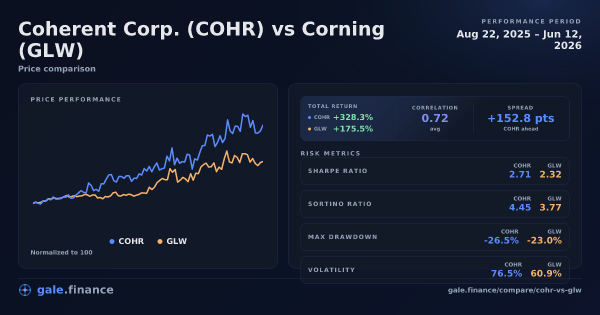
Over the past year, COHR outperformed GLW. COHR returned +239.1% compared with GLW’s +112.1%. COHR had the better risk-adjusted return, with a Sharpe ratio of 2.59 versus GLW’s 1.96. GLW was less volatile than COHR, and GLW had a smaller max drawdown than COHR.
Metric winners: Total Return: COHR; Sharpe Ratio: COHR; Annualized Volatility: GLW (less volatile); Max Drawdown: GLW (smaller drawdown).
Cite This Comparison
"Coherent Corp. vs Corning (COHR vs GLW): Returns, Risk & Volatility (2026)." Gale Finance, October 7, 2026. https://www.gale.finance/compare/cohr-vs-glw/ Free to use with attribution. Please link back to this page or gale.finance.
Relative Performance of COHR vs GLW (Normalized to 100)
Normalized to 100 at start date for comparison
Trade COHR or GLW
Access these assets on trusted platforms.
Key Takeaways
- Total Return: COHR delivered a +239.1% total return, while GLW returned +112.1% over the same period. COHR outperformed on total returns.
- Risk-Adjusted Return (Sharpe Ratio): COHR had a higher Sharpe (2.59 vs 1.96), indicating better risk-adjusted performance.
- Volatility (Annualized): COHR was more volatile, with 80.7% annualized volatility, versus 65.4% for GLW.
- Maximum Drawdown: GLW's maximum drawdown was -23.0%, while COHR experienced a deeper drawdown of -26.5%.
- Tail Risk (VaR & Expected Shortfall): At the 5% level (daily log returns), COHR's VaR was -8.30% and its Expected Shortfall (CVaR) was -10.55%; GLW's were -7.23% and -8.43%. VaR is the cutoff; Expected Shortfall is the average move on the worst days.
- Skew & Kurtosis: Skew: COHR -0.02 vs GLW 0.17. Excess kurtosis: COHR 0.86 vs GLW 1.21. Negative skew leans downside; higher excess kurtosis means fatter tails.
- Tail Days & Extremes: 2σ tail days (down/up): COHR 8/4, GLW 7/5. Worst day: COHR -11.44% (2026-06-09) vs GLW -10.18% (2026-06-05). Best day: COHR +18.32% (2025-11-06) vs GLW +15.58% (2026-01-27).
- Risk ratios: Sortino - COHR: 4.21 vs. GLW: 3.17 , Calmar - COHR: 19.00 vs. GLW: 8.81 , Sterling - COHR: 32.37 vs. GLW: 12.39 , Treynor - COHR: 0.70 vs. GLW: 0.50 , Ulcer Index - COHR: 8.98% vs. GLW: 8.73%
Investment Comparison
If you invested $10,000 in each asset on October 7, 2025:
Difference: $12,693.96 (COHR ahead)
Coherent Corp. vs Corning Performance Over Time
| Metric | COHR | GLW |
|---|---|---|
| 30 Days | -4.6% | -13.1% |
| 90 Days | 58.6% | 39% |
| 180 Days | 115.9% | 103.6% |
| 1 Year | N/A | N/A |
Shorter time frames can show different leaders as market conditions change. Consider your investment horizon when comparing performance.
Coherent Corp. vs Corning Correlation

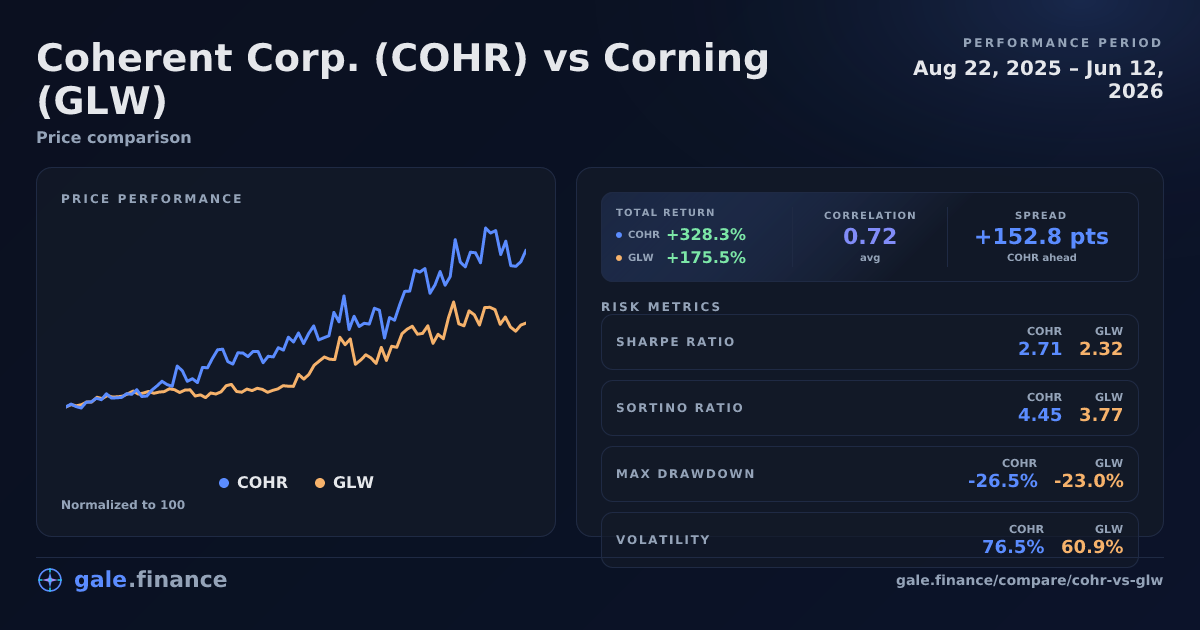
Coherent Corp. and Corning are strongly correlated over the past 6 months. With a correlation of 0.76, these assets tend to move together, limiting diversification benefits.
For portfolio construction, this strong correlation means holding both COHR and GLW provides limited risk reduction — they're likely to decline together in downturns.
| Metric | Value |
|---|---|
| Current (30-day) | 0.82 |
| Average (full period) | 0.76 |
| Minimum (30-day rolling) | 0.61 |
| Maximum (30-day rolling) | 0.89 |
Correlation measures how closely two assets move together. Values near +1 indicate strong co-movement, near 0 indicates independence, and negative values indicate inverse movement. Current, minimum, and maximum figures are 30-day rolling correlations on shared daily returns.
Drawdown
Coherent Corp. experienced its maximum drawdown of -26.5% from 2026-03-02 to 2026-03-30. It took 11 days to recover.
Corning experienced its maximum drawdown of -23% from 2026-02-25 to 2026-03-06. It took 33 days to recover.
Smaller drawdowns and faster recoveries indicate lower downside risk and greater resilience during market stress.
Coherent Corp. vs Corning Volatility (COHR vs GLW)
Coherent Corp.'s 80.7% annualized volatility translates to about ±5.09% one-standard-deviation daily volatility.
Corning's 65.4% annualized volatility translates to about ±4.12% one-standard-deviation daily volatility.
COHR had the wider volatility profile over this window. That means its day-to-day return distribution was broader; GLW was calmer, but lower volatility does not by itself mean better returns.
Treat the ± daily figure as a one-standard-deviation estimate from historical returns, not a forecast or expected absolute daily move. For context, 15-18% annualized volatility is roughly ±1% one-standard-deviation daily volatility.
Risk-adjusted ratios
Sharpe Ratio of COHR and GLW
Sharpe Ratio: COHR vs. GLW
Return per total volatilitySharpe gives us excess return per unit of risk. Upside and downside volatility both count as risk.
Sharpe ratio measures return per unit of risk (volatility). A higher Sharpe indicates better risk-adjusted performance. COHR had a higher Sharpe (2.59 vs 1.96), indicating better risk-adjusted performance.
A Sharpe above 1.0 is generally considered good, above 2.0 is excellent. Negative Sharpe means the asset underperformed the risk-free rate. Calculated on each asset's full 365-day lookback of available prices and annualized using the asset calendar (365 for crypto, 252 trading days for equities/ETFs/metals).
Sortino Ratio of COHR and GLW
Sortino Ratio: COHR vs. GLW
Return per downside volatilitySortino keeps the return-over-risk idea, but only returns below the target rate count as volatility.
Sortino ratio measures return per unit of downside risk. Unlike Sharpe, it only counts downside deviation (returns below the target return). COHR had better downside-adjusted returns.
A higher Sortino is better. It's useful when upside volatility is common (crypto is the obvious example). Downside deviation: COHR 49.6% vs GLW 40.4%. Calculated on each asset's full 365-day lookback of available prices, using the daily risk-free rate as the target return, and annualized using the asset calendar (365 for crypto, 252 trading days for equities/ETFs/metals).
Calmar Ratio of COHR and GLW
Calmar Ratio: COHR vs. GLW
CAGR per worst drawdownCalmar compares CAGR against the single deepest peak-to-trough loss over the period.
Calmar ratio compares CAGR to maximum drawdown. Higher Calmar means more return per unit of worst drawdown. COHR posted the higher Calmar ratio.
Calmar is computed on each asset's full 365-day lookback and uses the max drawdown over that same window.
Sterling Ratio of COHR and GLW
Sterling Ratio: COHR vs. GLW
Return per average drawdownSterling smooths the drawdown penalty by using average drawdown events instead of only the worst one.
Sterling ratio measures excess return per unit of average drawdown (typically drawdowns worse than 10%). COHR posted the higher Sterling ratio.
Sterling uses average drawdown events deeper than 10% and subtracts the risk-free rate to report excess return.
Treynor Ratio of COHR and GLW
Treynor Ratio: COHR vs. GLW
Excess return per market betaTreynor divides excess annualized return by beta — the sensitivity of the asset to broad-market moves. The slope shown is each asset’s beta vs SPY.
Treynor ratio measures excess return per unit of market risk (beta) instead of total volatility. COHR posted the higher Treynor ratio.
Treynor uses beta vs the S&P 500 (SPY) on shared dates and the average 3-month Treasury rate as the risk-free rate.
Ulcer Index of COHR and GLW
Ulcer Index: COHR vs. GLW
Drawdown painUlcer Index is a risk index, not a return-over-risk ratio. Lower means smaller and shorter drawdowns.
Ulcer Index captures drawdown depth and duration. Lower Ulcer Index means less drawdown pain. GLW had the lower Ulcer Index (less drawdown pain).
Ulcer Index is computed from each asset's drawdown series over the full lookback window.
Tail Risk & Distribution Shape (1-Year): Coherent Corp. vs. Corning
This section looks at the shape of daily returns, not just the average. Tail stats are computed per asset on its own daily series (crypto includes weekends). We use daily log returns so multi-day moves add cleanly.
Definitions: Value at Risk (VaR), Expected Shortfall, skew, kurtosis, and fat tails.
Tail Risk & Distribution Shape: COHR vs. GLW (1-Year)
Actual daily return tailsThe bars are real daily log-return observations from the article window. Darker bars are observations at or beyond each asset’s 5% VaR cutoff.
| Metric (1-Year) | COHR | GLW |
|---|---|---|
| 5% VaR (daily log return) | -8.30% | -7.23% |
| 5% Expected Shortfall (CVaR) | -10.55% (worst 9 days) | -8.43% (worst 9 days) |
| Skew | -0.02 | 0.17 |
| Excess kurtosis | 0.86 | 1.21 |
| 2σ tail days (down / up) | 8 / 4 | 7 / 5 |
| Worst day | -11.44% (2026-06-09) | -10.18% (2026-06-05) |
| Best day | +18.32% (2025-11-06) | +15.58% (2026-01-27) |
Downside co-moves (2σ) — 1-Year
Computed on shared dates only (n=171). A “2σ downside move” means a shared-close log return more than 2 standard deviations below that asset’s own mean on this shared-date series. Dates below show simple returns (%) for readability.
Downside co-move map: COHR vs. GLW (2σ)
Shared-close daily returnsDots mark actual downside days: asset-colored dots are one-sided downside moves, and red dots are joint downside days. Grey dots add sampled shared-return context when available. The shaded lower-left zone shows where both COHR and GLW crossed their own 2σ downside threshold.
Show downside tail dates
Dates below are shared-date observations. The “Date” is the period end (close). Tail thresholds are computed on log returns, but the table shows simple returns (%) for readability. Returns are computed from the previous shared close to this one (for example, Friday → Monday includes weekend moves).
Days when both COHR and GLW had a big down day (2σ)
| Date (interval) | COHR | GLW |
|---|---|---|
| 2025-11-13 | -10.66% | -7.47% |
| 2025-12-12 | -10.16% | -7.97% |
| 2026-03-26 | -10.57% | -7.54% |
| 2026-06-05 | -10.64% | -10.18% |
Days when COHR had a big down day
| Date (interval) | COHR | GLW |
|---|---|---|
| 2025-10-10 | -9.19% | -4.83% |
| 2025-11-13 | -10.66% | -7.47% |
| 2025-12-12 | -10.16% | -7.97% |
| 2026-01-08 | -9.64% | -3.02% |
| 2026-03-26 | -10.57% | -7.54% |
| 2026-03-27 → 2026-03-30 | -9.79% | -6.04% |
| 2026-06-05 | -10.64% | -10.18% |
| 2026-06-09 | -11.44% | -7.25% |
Days when GLW had a big down day
| Date (interval) | COHR | GLW |
|---|---|---|
| 2025-11-13 | -10.66% | -7.47% |
| 2025-12-12 | -10.16% | -7.97% |
| 2026-03-06 | -7.15% | -8.50% |
| 2026-03-26 | -10.57% | -7.54% |
| 2026-04-28 | -5.46% | -8.90% |
| 2026-05-15 | -5.55% | -7.91% |
| 2026-06-05 | -10.64% | -10.18% |
Read this as “how ugly the ugly days get”, not as a precise forecast. One-year samples are small, so tail estimates are inherently noisy.
Full Comparison of Coherent Corp. vs. Corning (1-Year)
| Metric | COHR | GLW |
|---|---|---|
| Total Return | +239.1% | +112.1% |
| Annualized Volatility | 80.7% | 65.4% |
| Sharpe Ratio | 2.59 | 1.96 |
| Sortino Ratio | 4.21 | 3.17 |
| Calmar Ratio | 19.00 | 8.81 |
| Sterling Ratio | 32.37 | 12.39 |
| Treynor Ratio | 0.70 | 0.50 |
| Ulcer Index | 8.98% | 8.73% |
| Max Drawdown | -26.5% | -23.0% |
| Avg Correlation to S&P 500 | 0.51 | 0.52 |
| 5% VaR (daily log return) | -8.30% | -7.23% |
| 5% Expected Shortfall (CVaR) | -10.55% | -8.43% |
| Skew | -0.02 | 0.17 |
| Excess kurtosis | 0.86 | 1.21 |
| 2σ tail days (down / up) | 8 / 4 | 7 / 5 |
Audit this calculation
Formulas, inputs, and conventions used to compute the metrics on this page.
Inputs & conventions
- Shared window for pair metrics
- 2025-10-07 → 2026-06-12 (last shared close).
- Rolling correlation sample (shared closes)
- 142 rolling 30-day values (from 171 shared daily returns).
- Annualization (days/year)
- COHR: 252 days/year; GLW: 252 days/year.
- Risk-free rate
- Uses the 3-month U.S. Treasury yield (FRED: DGS3MO), averaged over each asset’s window:
- COHR: 3.75% over 2025-10-07 → 2026-06-12.
- GLW: 3.75% over 2025-10-07 → 2026-06-12.
- Volatility drag (rule of thumb)
- Estimated from annualized volatility (simple returns). For the log-return framing, see Log returns.
- COHR: ≈ -32.6%/yr
- GLW: ≈ -21.4%/yr
- Data alignment
- No forward fill. Correlation and tail co-moves are computed on shared closes only. For cross-calendar pairs (e.g., crypto vs stocks), weekend/holiday moves roll into the next shared close.
- Return conventions
- Volatility/Sharpe/Sortino use simple daily returns. Tail-risk uses daily log returns for distribution stats (but tables show simple returns). Log returns.
Formulas
- Price on day t.
- Simple daily return.
- Log daily return.
- Average daily return.
- Standard deviation of daily returns.
- Annualization factor (days/year).
- Annual risk-free rate.
Coherent Corp. vs Corning: Frequently Asked Questions
Which has higher volatility: COHR or GLW?
COHR showed higher volatility at 80.7% annualized, compared to 65.4% for GLW Over the past 6 months. Higher volatility means larger price swings in both directions.
Does COHR provide diversification when held with GLW?
COHR and GLW are strongly correlated over the past 6 months, with an average correlation of 0.76. This strong correlation limits diversification benefits.
How bad are the worst 5% days for COHR vs GLW?
Over the past 6 months, COHR's 5% VaR was -8.30% and its 5% Expected Shortfall was -10.55% (worst 9 days). GLW's were -7.23% and -8.43% (worst 9 days).
Do COHR and GLW crash together on bad days?
On shared dates (n=171), when GLW has a 2σ down day, COHR also does 57.1% (4/7 days). In the other direction, when COHR has one, GLW also does 50.0% (4/8 days).
Which has better risk-adjusted returns: COHR or GLW?
COHR showed better risk-adjusted performance with a Sharpe ratio of 2.59 versus GLW's 1.96 Over the past 6 months.
Can COHR and GLW be combined in a portfolio?
Yes, though allocation sizing matters. Their strong correlation provides limited risk reduction since they tend to move together. COHR's higher volatility (80.7%) means even small allocations can materially impact overall portfolio risk.